
The client you keep
A client with $3,000,000 of facilities at 0.25% per annum trail is $7,500 a year, every year they stay. Lose one at a renewal you did not see coming and that income stops, along with the refinance you would have written.
For commercial finance brokers and advisers
Aprio reads the documents, holds the current position for every client group, benchmarks the pricing and tracks what falls due. The renewal conversation starts with you.
The bank called a month out. The broker never did.
That is how a good broker loses a client they had done nothing wrong by. There was simply no consistent and accurate way of seeing the renewal coming.
Repeat clients and referrals are where commercial broking income actually comes from. Both follow from being the person who saw it coming.
Know where every client stands, by date, across the book, so the call happens three months out rather than three days late. Invite the client into their own group and they see the work between deals instead of only at the next one. And when they ask what they are paying, you already know the all-in number and what it would be if it rolled today.
Their financial accounts turn into a forecast and a three-way model without anyone re-keying a figure, which takes the Friday afternoon out of every submission. The same numbers show the headroom in a lazy balance sheet, so you can size the next deal before credit does.
Engaged clients who are growing introduce other clients. The broker who arrives with the forecast and the capacity already worked out gets the deal and the introduction after it.
A client with $3,000,000 of facilities at 0.25% per annum trail is $7,500 a year, every year they stay. Lose one at a renewal you did not see coming and that income stops, along with the refinance you would have written.
Headroom you can see is a deal you can raise. A $1,000,000 increase at 0.25% per annum trail adds $2,500 a year, before the upfront on the new facility. The balance sheet and debt servicing show what it supports before credit does, so the conversation starts with an opportunity instead of a request.
Management accounts become actuals, forecast months and a three-way model without anyone rekeying a figure. At four hours of analyst time a submission and $90 an hour, that is $360 a submission, or $7,200 across twenty submissions a year.
Give Aprio the documents you, or the client, already have. Reading, extraction, modelling and benchmarking happen from those documents rather than from a form someone fills in.
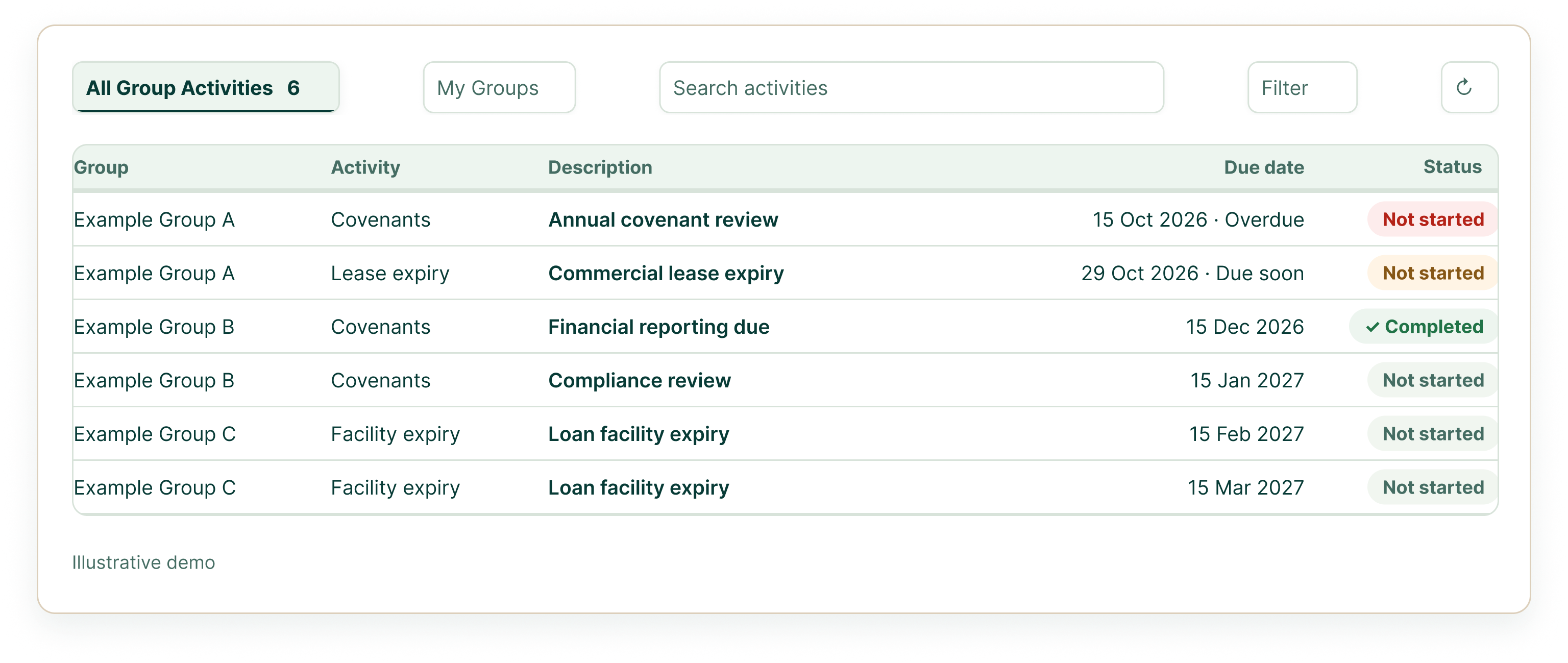
Facility expiries, balloon payments, covenant reporting, rent reviews and lease expiries in one list, filtered to the next twelve months. Click any activity to see the detail and open the document it came from.
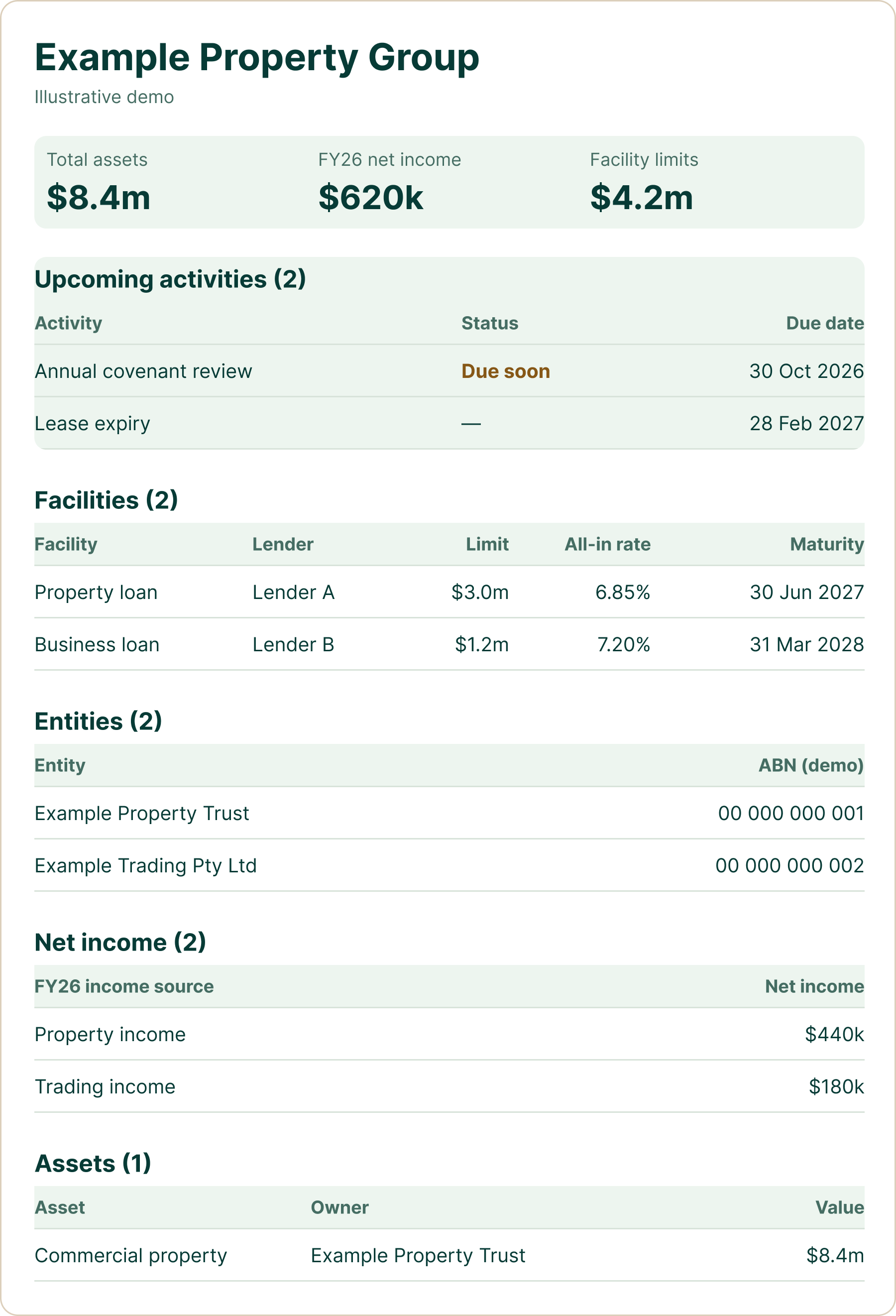
Entities, securities, facilities across lenders, assets, leases, income and upcoming activities. See the latest position across the group, and the history when you need it. Variations are overlaid on the agreement they amend, so there is one source of truth and a link back to the document each figure came from.What Aprio reads →
The all-in rate from the letter of offer and any subsequent variations, kept current and benchmarked against the market, with reference rates by pricing period. Details that most clients have not looked at since settlement.
Accounts become actuals plus forecast months and a three-way model exported to Excel with working formulas, consolidated across the group. Loans and asset finance come back as amortisation schedules, balloon payments included. The next submission stops starting from a blank spreadsheet.
LVR, ICR and DSCR from the client's own figures, so the constraint on the next deal is able to be discussed with the client as part of their decision-making process. Ask what a shorter pricing period would mean, or what the debt servicing income and balance sheet could support at a given yield, and it answers against this client's documents. It also flags what it is unsure of first.
Invite a client into their own group and they see the value you are adding: their current position, the activities coming up, and with visibility they can stop being caught out by a balloon payment. They can upload new documents, so you, the client and their accountant all work from the same latest numbers.
The first question every broker asks is who else can see the book. The answer is nobody.
We never contact your clients, quote them or refer them anywhere. No leads flow out of your book. Our intent is the opposite: that Aprio makes leads flow into it.
You decide which of your people can open which client group, and at what access level.
An audit log records who opened what and when, available to you on request.
No lender pays us and we promote no products.
Your data always remains your data. It is encrypted and held in Australian data centres.Security, governance and AI →
Four entities, two lenders, a commercial property and an equipment facility. This is how the file runs.
Monday morning
Two facility agreements, three letters of variation, a lease, an asset finance contract, a valuation and last year's financials. You upload them, or the client does it from their own login.
Five to ten minutes later
Four entities linked to their securities and facilities. Current limits and margins after every variation, the amortisation schedule on the equipment facility with its balloon, the lease expiry, and the all-in rate against the benchmark.
Before you call the bank
The accounts become monthly actuals and forecast months, exported to Excel as a three-way model you finish yourself. LVR sits comfortably; interest cover is the constraint, which is what you take into the conversation.
Nine months later
The covenant test and the facility expiry surface in your activities list while there is still time to shop it. You call the client. The bank does not get there first.
Whenever it matters
Structures, securities, terms, schedules and review history sit in the record. Someone else in the firm can pick the client up, and a buyer or an incoming partner can see what is there.
See it against a file you already know, and judge the extraction and the benchmark for yourself.
The walkthrough runs on live data for a fictitious client rather than a canned demo, online or in your office. You see the activities list, the group overview, the pricing and the three-way model, and you can bring a file of your own. Nothing to install, and no obligation at the end of it.
Tell us a bit about your firm, and we will come back with times.
No. Client groups are visible to the people in your firm you give access to, and to a client you choose to invite into their own group. Access is logged. Aprio staff access client data only where you ask us to, for support.
No. Aprio is not a broker and holds no credit licence to act as one. We do not market to your clients or refer them anywhere.
Aprio does not refinance anything, deal with lenders, or arrange finance. Nothing moves unless you move it.
Run it against retention rather than hours saved. One client with $3,000,000 of facilities at 0.25% per annum trail is $7,500 a year for as long as they stay, so the question is how many clients the firm has to keep for the subscription to pay for itself. Take the two or three commercial clients you would least like to lose, put your own facility sizes and trail rate through the same arithmetic, and compare it with the annual cost for the number of clients you would load.
Loan and asset finance agreements, variations, leases, tenancy schedules, valuations, financial statements and management accounts. Coverage is strongest on major bank documentation; private lender agreements vary and are not yet supported.See what Aprio reads →
See the current subscriptions and inclusions on our pricing page.See pricing →
No. It is an indicative reference range built on commercial broking experience and the metrics credit teams price against. It is not an offer, and no lender is bound by it.
Commercial finance isn’t something to set and forget. Businesses put real effort into their P&L, and plenty of time and money goes into managing tax. Yet interest expense, the line between operating profit and tax, often gets no proactive management at all.
Aprio began from a frustration our founders had as borrowers. We didn’t always know whether our debt was competitively priced, when the next review was due or when covenants needed reporting. Working in banking and broking, we also saw that borrowers needed ongoing care they often didn’t get, because keeping track of it all came down to manual spreadsheets.
So we built Aprio. It brings every facility into one view, tied to your assets and income, so your debt gets the same attention as every other material line on the P&L. Understand it, pay less for it, and use it to grow.

Co-founder
Darren and his wife have had commercial debt since she bought her business in 2004, and they have since added property interests to the mix. He spent 13 years in corporate and business banking with one of the big four banks, so he knows how lenders price loans, assess credit and set terms. Since 2014 he has used that knowledge as an independent broker. Darren brings that experience as a borrower, banker and broker to Aprio.

Co-founder
Paul has spent seven years in finance and debt advisory, specialising in commercial broking since 2021. He works mainly with property investors and trading businesses. He knows where a broker’s time actually goes: the same numbers rebuilt for every submission, the file pieced together again before every review. That’s time that should go into looking after borrowers, and he shapes Aprio around giving it back. Paul brings that experience from the broker’s side of the desk to Aprio.

Co-founder
Lachlan has spent more than 25 years in technology. He founded and grew CRM consultancy Bright Blue Solutions before selling it to a public company. He then spent seven years at Microsoft, the last five as a Data and AI Specialist. He also owns commercial property, and has carried the debt that comes with it since 2014. Lachlan brings that experience as a founder, technologist and borrower to Aprio.